"The technology works." It is a phrase often heard when discussing aquathermal energy (AQE). Across Europe, hundreds of technical feasibility studies have already confirmed the enormous potential of water as a local source of renewable heat.
So why do so many promising projects struggle to move beyond the drawing board?
Technology alone does not deliver an energy project. Long-term success depends just as much on finance, governance and citizens' trust as it does on engineering. That is where a comprehensive business model becomes key to bringing an aquathermal energy project to life.
Planning a viable service for the long run
An aquathermal district heating network is not simply an infrastructure project. It is a service that will operate every day for decades, supplying reliable heat to citizens whose expectations, energy needs and budgets will inevitably evolve over time.
Within AquaCOM, we encourage project developers to think of AQE development as three connected stages:
- Feasibility study: answers the fundamental "go/no-go" question by assessing technical, financial and legal feasibility. It estimates investment and operating costs, energy production and network sizing, and identifies potential risks before construction begins.
- Business model: transforms technical results into a long-term financial strategy, testing whether the project will remain economically sustainable throughout its lifetime by weighing revenues, operating costs, financing conditions and available subsidies.
- Service-level agreement: defines how the heat supply service will operate, establishes responsibilities, and provides a transparent framework between the network operator and connected end-users.
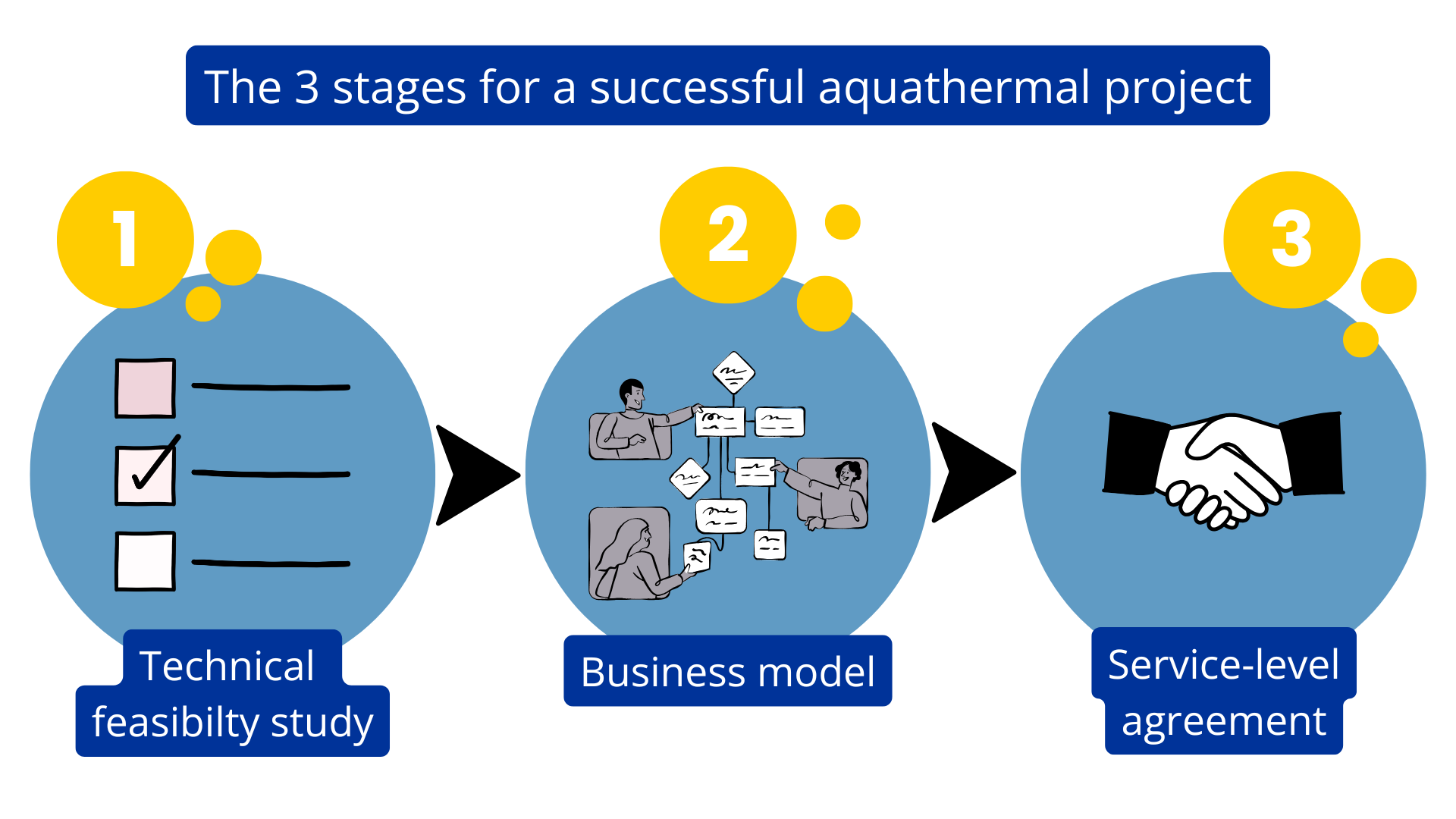
Only when these three pieces fit together can an aquathermal project confidently move towards implementation.
A business model is much more than a spreadsheet
The words "business model" often evoke complex financial tables buried at the end of a report. In reality, it should be seen as one of a project's most valuable decision-making tools.
A well-designed business model connects engineering with reality. It brings together technical outputs from the feasibility study with assumptions on investment costs, operation and maintenance, financing, subsidies, electricity prices, inflation, network efficiency and future user demand.
The result is far more than a budget — it becomes a living model capable of answering questions that every project developer, energy community, investor and public authority will eventually ask:
- Can the network remain financially balanced if electricity prices rise?
- What happens if fewer customers connect than initially expected?
- How much does a higher-performing heat pump improve project economics?
- Would extending the network create more value or more risk?
- When does the project become profitable?
Instead of relying on intuition, decision-makers can test different scenarios before a single metre of pipe is installed.
Citizens are part of the business model
One of the biggest lessons from district heating projects across Europe (and from our AquaCOM pilots) is that success is measured not only by technical performance, but also by local community acceptance.
A comprehensive business model addresses the questions that matter most to the target community: whether the proposed heat price will remain attractive over time, whether users benefit from stable energy costs, and whether the service offers sufficient value compared with existing heating solutions. These priorities vary by user type: a hospital may prioritise energy security, whereas a social housing provider will value low prices.
From theory to practice: the French example
This is precisely the approach adopted by AquaCOM partner SPL Bois Énergie Renouvelable (SPL BER) for the proposed aquathermal district heating network in Lorient city centre.
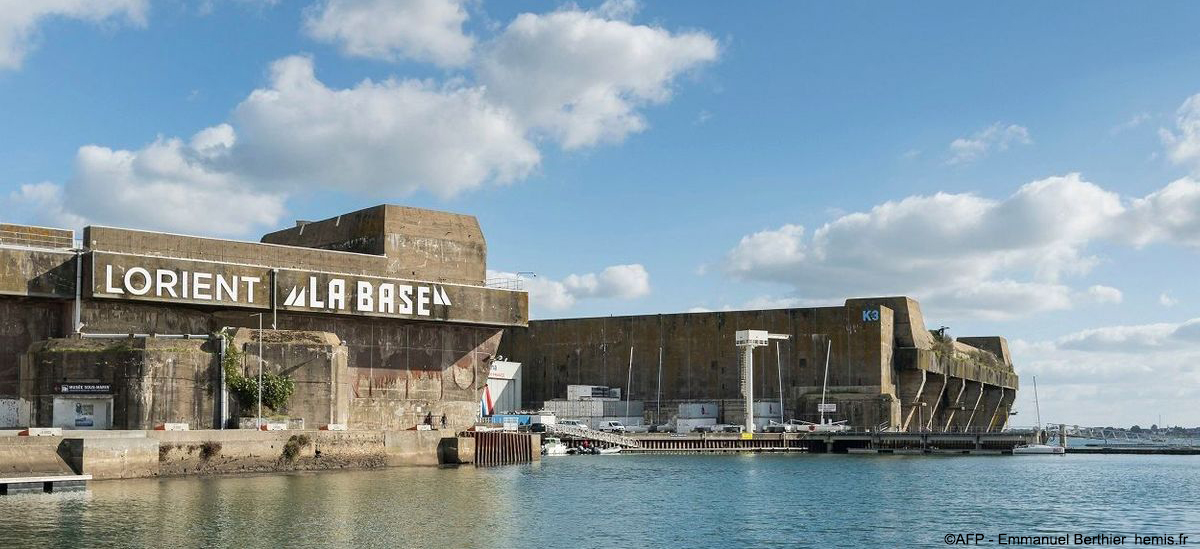
Following the technical feasibility study conducted as part of the French AquaCOM pilot - which demonstrated that recovering heat from seawater could supply a future district heating network -, the business model incorporated financing assumptions, operating costs, maintenance, depreciation, subsidies and projected revenues to simulate the network's financial performance over several decades.
Rather than producing a single financial result, the model became a strategic planning tool, helping answer questions such as:
- Is the proposed tariff competitive?
- Which costs have the greatest influence on profitability?
- Which assumptions carry the highest financial risk?
- Where should the project be optimised before construction begins?
This approach allows decisions to be based on evidence and helps manage the uncertainty inherent in project development, reducing risk for the energy community, municipality or investors behind the proposal.
Building confidence, not just infrastructure
Europe's energy transition will require thousands of new renewable heating projects over the coming decades. This summer's record-breaking temperatures across the continent are a stark reminder of the urgent need to cut carbon emissions. Aquathermal energy has enormous potential to contribute to this transformation, particularly in cities and regions located near rivers, lakes, ports and coastlines.
Yet ambitious projects will only succeed through collaboration between engineers, economists, public authorities, utilities, investors and citizens. A comprehensive business model provides the common language that brings all these stakeholders together, transforming technical feasibility into investment confidence, financial sustainability and long-term public value.